WordPress vs New Zenler? Choosing the Right Engine for Your Online School in 2026
 Niraj Kumar
You have the knowledge, the curriculum is ready, and you’re excited to share it with the world. But then comes the big question that halts every exper
Introduction: Powering Your Online School's Tomorrow
Choosing the right platform for your online school is no longer just a technical decision; it's a strategic one that will define your business's trajectory for years to come. In an industry projected to become a $1 trillion global market by 2032, the foundation you build today must support the innovations of tomorrow. This guide moves beyond simple feature lists to compare two fundamentally different philosophies for building a digital education empire: the boundless customization of WordPress versus the integrated efficiency of New Zenler.
The Evolving Landscape of Online Learning (2026 Perspective)
By 2026, the online learning space has matured. Learners expect seamless, engaging experiences that blend content, community, and interaction. The novelty of simply putting videos behind a paywall has faded. Success now hinges on creating a holistic digital ecosystem. This means your platform isn't just a content delivery system; it's your marketing engine, your community hub, and your brand's digital home.
The Core Question: Integrated Simplicity vs. Unbound Customization
The choice between WordPress and New Zenler boils down to a single, critical question: Do you want to build a custom-designed vehicle from the ground up, or do you need a high-performance, ready-to-drive machine straight from the factory? One offers ultimate control and a unique identity; the other offers speed, reliability, and an all-in-one feature set designed to get you on the road immediately.
Understanding the "Engine" Metaphor: Built-in vs. Build-Your-Own
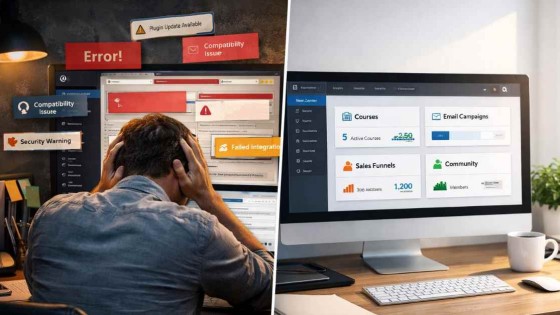
Think of your online school platform as its engine. New Zenler provides a fully assembled, factory-tuned engine where the course builder, marketing funnels, and community are all integrated parts. It’s designed for peak performance with minimal tinkering. WordPress provides the engine block—a powerful and reliable core. It's up to you to select, install, and maintain the turbochargers (LMS plugins), fuel injection systems (marketing apps), and exhaust (community tools) to build your unique performance machine.
Who This Guide Is For: Navigating the Digital Learning Platform Choice
This guide is for educators, entrepreneurs, and experts at a crossroads. Whether you're a first-time course creator overwhelmed by options or an established brand considering a platform migration, this analysis will provide the clarity needed to choose the engine that best powers your vision for 2026 and beyond.
Meet the Engines: WordPress (with LMS) vs. New Zenler
Let's look under the hood of our two contenders to understand their core architecture and philosophy.
WordPress: The Customizable Foundation for Your Online School
WordPress is the world's most popular content management system, powering over 40% of the web. It's open-source, meaning you own your code and have complete control over every aspect of your site. To transform it into an online school, you integrate a Learning Management System (LMS) plugin, such as LearnDash or Tutor LMS. The popularity of this approach is surging, with WordPress e-learning plugins seeing a 50% increase in downloads in 2025. This "build-your-own" model allows you to create a truly bespoke platform, integrating best-in-class tools for every function, from community platforms like Circle to advanced marketing automation.
New Zenler: The All-in-One Digital Learning Ecosystem
New Zenler is an integrated platform designed specifically for course creators. It consolidates all the essential tools into a single, cohesive system: course creation, a website builder, email marketing, sales funnels, a community space, live classes, and even a mobile app. It operates on a "what you see is what you get" philosophy, aiming to eliminate technical friction so you can focus on creating and selling courses. It competes in a bustling market against alternatives like Kajabi, Kartra, and Teachable, but often at a more accessible price point. The total LMS market, which includes platforms like New Zenler, is expected to reach $29.9 billion by 2025.
Core Course Creation & Content Delivery: Building Engaging Learning Experiences
The heart of any online school is its ability to deliver high-quality learning content effectively.
Course Structure and Supported Content Formats
Both platforms offer robust course builders. New Zenler provides a streamlined, intuitive interface for structuring modules and lessons. You can easily upload videos, audio, PDFs, and text, with built-in video hosting. WordPress, via LMS plugins, offers similar capabilities but with greater potential for customization. You can create complex lesson hierarchies and leverage the vast ecosystem of WordPress apps to embed virtually any type of content, though video hosting typically requires a third-party service like Vimeo or Wistia.
Assessment Tools and Certification
New Zenler comes equipped with native quizzes, assignments, and surveys. You can set passing grades and automatically issue customized completion certificates. WordPress LMS plugins also offer powerful quizzing functionalities, often with more advanced question types and logic. Certification can be handled by the LMS plugin itself or through dedicated certificate apps that offer greater design flexibility.
Gamification and Engagement Features
Engagement is key to student success. New Zenler includes built-in gamification features like course completion points and progress tracking. WordPress, true to form, allows for more advanced and customized gamification. With specific plugins, you can add points, badges, leaderboards, and rewards that are deeply integrated into every aspect of your site, far beyond just the courses.
Community, Interaction, and Membership: Fostering Connection and Loyalty
A thriving community can transform a simple course into a valuable, long-term membership.
Building and Managing Your Learning Community
New Zenler provides a built-in community feature that functions like a private social media feed for your school. Students can post, comment, and interact within a branded environment, directly tied to their course experience. The WordPress approach involves either using a forum plugin like bbPress or, more commonly, integrating a dedicated community platform like Circle. This offers a more powerful, specialized community experience but adds another subscription and layer of technical integration.
Membership Sites and Recurring Revenue Models
Both platforms excel at creating membership sites. New Zenler allows you to bundle courses and community access into subscription tiers directly within the platform. WordPress offers unparalleled flexibility here. Using powerful membership plugins, you can create intricate subscription models, tiered content access, and complex recurring revenue streams that are impossible on most all-in-one platforms.

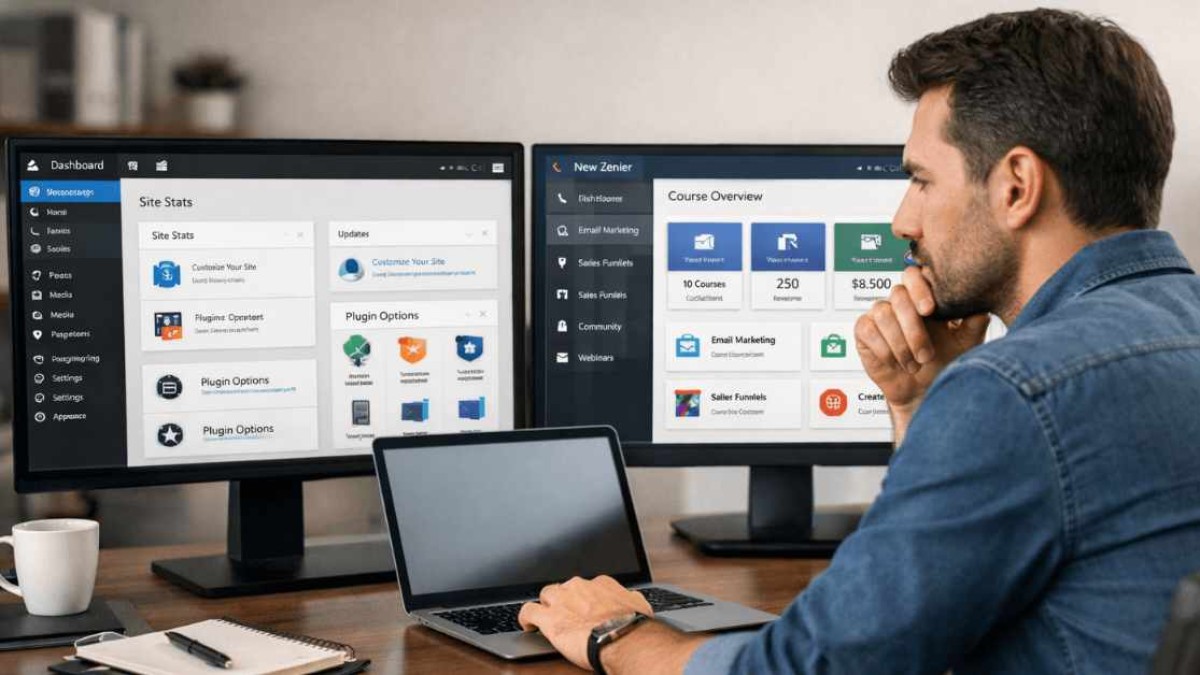
The 'Engine' Metaphor: New Zenler provides an all-in-one, integrated system, while WordPress offers a core foundation that you build upon with specialized plugins and tools.
Live Learning and Interactive Sessions
New Zenler has a significant advantage with its native live class and webinar functionality, powered by its own "Zenler Live" technology. You can host interactive sessions, meetings, and live streams directly from your platform without needing third-party tools. For WordPress, this requires integrating with external services like Zoom or YouTube Live, which can be connected via Zapier or specific plugins to handle registration and access.
Marketing, Sales, and Monetization: Driving Growth for Your Online School
A great course is useless if no one knows it exists. Marketing and sales capabilities are critical.
Sales Funnels and Landing Pages for Conversion
This is where New Zenler shines for non-technical users. It includes a built-in visual funnel builder and page editor, allowing you to create marketing funnels, landing pages, and checkout sequences with ease, similar to platforms like Kartra. In WordPress, you achieve this by combining a page builder plugin (like Elementor) with a cart system (like WooCommerce) and marketing automation tools, offering more power but requiring more setup.
Payment Processing and E-commerce Capabilities
Both systems integrate with major payment gateways like Stripe and PayPal. New Zenler handles transactions, tax calculations (in some cases), and affiliate management natively. WordPress, typically paired with WooCommerce or a similar e-commerce plugin, becomes a full-fledged online store. This allows for selling physical products alongside courses and offers far more advanced e-commerce features, payment gateway options, and international tax handling.
Email Marketing and CRM Functionality
New Zenler includes a built-in email marketing and automation system. You can tag students based on behavior, send broadcast emails, and create simple automated sequences. While convenient, it's less powerful than dedicated providers. WordPress allows you to integrate with any best-in-class email marketing platform (like ActiveCampaign or ConvertKit), providing superior CRM, segmentation, and automation capabilities.
Analytics, Reporting, and Performance Monitoring
New Zenler offers a clean, centralized dashboard for tracking sales, student progress, and engagement. WordPress reporting depends on your chosen plugins. A combination of your LMS reports, Google Analytics, and marketing plugin dashboards provides deeper, more granular data but requires you to consolidate information from multiple sources.
Technical Foundations: Hosting, Security, and Integrations
The underlying technology determines your school's performance, security, and ability to connect with other tools.
Hosting and Performance Considerations
With New Zenler, hosting is included. They manage server performance, uptime, and content delivery, so you never have to think about it. With WordPress, you are responsible for choosing and paying for your own hosting. This is an added cost and responsibility but gives you full control to choose a provider optimized for speed and scalability as you grow.
Security and Updates in 2026
Security is a shared responsibility with WordPress. You must manage updates for the core software, your theme, and all plugins, and implement security measures to protect your site. New Zenler, as a SaaS (Software as a Service) platform, handles all security and updates behind the scenes, providing peace of mind for the less technically inclined.
Integrations and Extensibility for a Holistic Solution
New Zenler offers a selection of native integrations and a Zapier connection for everything else. WordPress is the undisputed king of extensibility. With a library of over 50,000 plugins and the ability to integrate with virtually any service via API or tools like Zapier, its potential to connect and expand is nearly limitless.
Scalability, AI, and Future-Proofing for 2026 and Beyond
Your choice today impacts your ability to adapt to the future of e-learning.
Adaptability to Emerging Technologies and Learning Trends
The open-source nature of WordPress means it can adapt to any new technology. As new learning models or tech emerge, a plugin or integration will inevitably be developed for it. New Zenler's adaptability depends on its internal development roadmap. You are reliant on the company to innovate and integrate new trends, which can be a pro (it's done for you) or a con (you have to wait). While the market is growing, some platforms see fluctuations; for instance, Zenler stores saw a decrease in one quarter of 2025, highlighting the dynamic nature of the industry.
Long-Term Growth and Traffic Handling
Both platforms can support significant growth. A WordPress site on high-quality hosting can handle millions of visitors. New Zenler is also built to scale, handling the backend infrastructure for you. The key difference is cost and control; scaling on WordPress means upgrading your hosting plan, while scaling on New Zenler is seamless but within their ecosystem.
AI Integration for Course Creation and Marketing (2026 Forecast)
By 2026, AI is no longer a novelty but a standard tool. Platforms like Thinkific and Kartra are already integrating AI for course outlining and marketing copy. New Zenler is actively adding AI features to its toolkit. On WordPress, you can integrate a wide array of specialized AI tools via plugins for everything from content creation and SEO to personalized learning paths, again offering more choice at the cost of more complexity.
Conclusion
Choosing between WordPress and New Zenler is a choice between two distinct paths to success in a market poised for explosive growth, with a projected compound annual growth rate of 17.58% from 2025 to 2032. There is no single "best" platform—only the one that is best for you.
Choose WordPress if you are a "Legacy Builder": You value ultimate control, brand ownership, and long-term customizability above all else. You want to build a completely unique digital asset and are comfortable managing the technical components or have the resources to hire help. Your vision requires integrating best-in-class tools for every function, creating a powerful, bespoke ecosystem.
The truth? There is no 'perfect' platform—only the perfect platform for your business goals. Choosing the wrong one can lead to a messy migration a year later. As a System Designer, I help you make this choice with confidence and then build the entire engine for you.
Confused? Let's hop on a 15-minute Strategy Call and pick your engine together.
Categories: : Comparison